2027 USPS GRI: What It Means for Shippers
USPS commercial rates rise an average of 5.9% on January 17, 2027, and the temporary 8% becomes a permanent fuel surcharge starting at 11%. Our analysis of USPS's own price files shows where shippers will pay more than the headline.
By Timur Eligulashvili, founder of SmallParcel.com
20+ years in parcel: Echo, LSO, uShip, ShippingEasy.
Updated November 2026 · 10 min read

The U.S. Postal Service (USPS) has filed its 2027 shipping prices with the Postal Regulatory Commission: commercial base rates rise an average of 5.9% on January 17, 2027, and the temporary 8% transportation charge that has sat in postage since April becomes a permanent fuel surcharge starting at 11%. This post covers commercial rates only.
Treat that number as a starting point, not a forecast. USPS does not raise every rate by 5.9%. It reprices every cell, service by service, zone by zone, weight by weight. We pulled USPS’s published price files for January 2026 and January 2027 and compared them cell by cell. The pattern underneath the headline: short zones and the lightest Ground Advantage parcels take the biggest base increases, and fuel lands on top of all of it.
The short version: 5.9% is the headline. Fuel is the bill.
What USPS filed
The filing is Docket No. CP2027-1. The Board of Governors approved the prices on November 9 (Governors’ Decision No. 26-8), and the commission reviews them before the January 17 effective date, so treat every number below as proposed until that review finishes.
The announced headline is 5.9%, USPS’s blended average across retail and commercial for the four domestic parcel services. The Governors’ Decision in the filing breaks the commercial averages out by service, and the commercial side lands at the same place:
| Service | Commercial increase |
|---|---|
| Priority Mail Express | 5.9% average |
| Priority Mail | 5.9% average |
| USPS Ground Advantage | 5.9% average |
| Parcel Select | 5.9% average (DDU entry 5.8%, DSCF entry 5.9%, Connect Local 6.0%) |
On top of the base increase, all four services get the fuel surcharge below. International shipping prices rise 7.9% on average and sit outside this post, and the surcharge does not apply to international products for now.
One timing note. The holiday prices expire January 17, but the new base rates and fuel surcharge start the same day. Do not assume your costs fall after peak.
Base rates: where the increase actually lands
Start with the floor, the lowest commercial weight based price on each service. The floor is what the lightest, closest parcel pays, no matter what else changes.
| Service | Jan 2026 floor | Jan 2027 floor | Change |
|---|---|---|---|
| Ground Advantage (4 oz, Zone 1) | $5.09 | $6.90 | +35.6% |
| Priority Mail (1 lb, Zone 1) | $8.37 | $9.31 | +11.2% |
The Ground Advantage floor jumps 35.6% because the lightest tier is where the July ounce pricing change and the January increase stack. The sections below break the increase down by weight and zone, from our own comparison of the January 2026 and January 2027 price files.
Ground Advantage: short zones and light weights pay the most
| Weight | Zones 1 to 4 | Zones 5 to 8 |
|---|---|---|
| 1 to 5 lb | +8.7% | +4.6% |
| 6 to 10 lb | +6.2% | +3.8% |
| 11 to 20 lb | +5.3% | +2.4% |
| 21 to 50 lb | +1.5% | +1.5% |
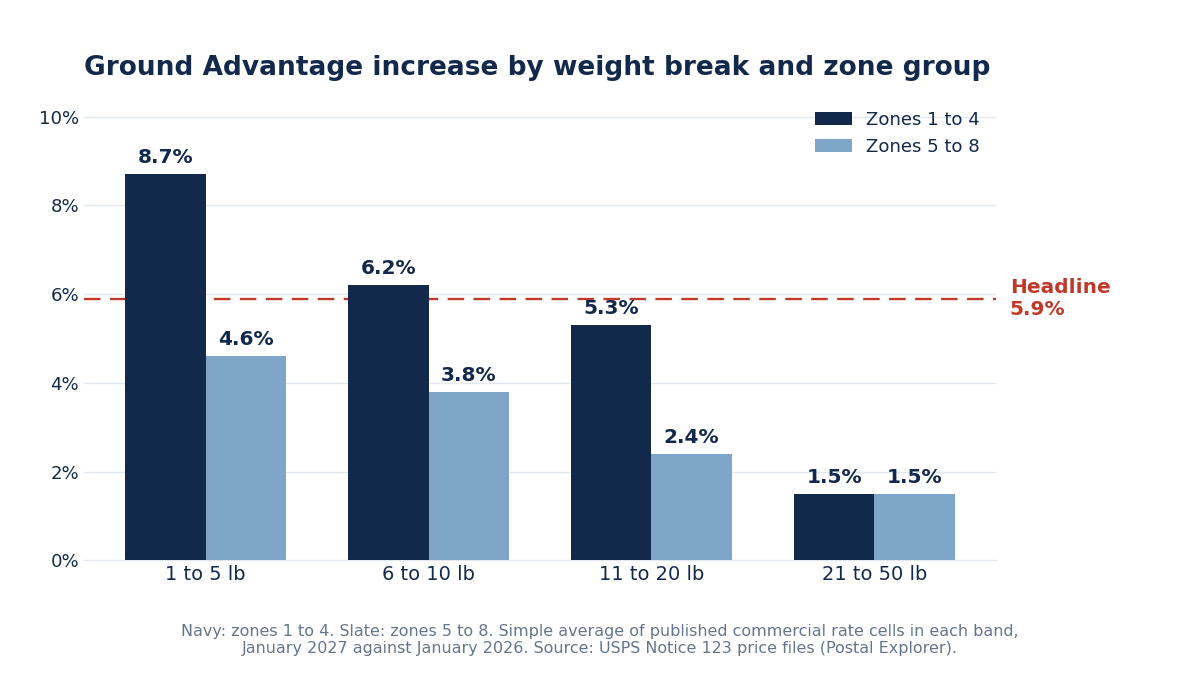
Up to 20 lb, short zones rise faster at every weight, and light weights rise faster in every zone group. The single 1 lb rate in zones 1 to 4 rises 11.9%. Heavy parcels are the exception: 21 lb and up rises 1.5% in every zone, and with fuel on top, a heavy parcel costs about 2% less in January than it does at today’s holiday price, because its holiday add-on today is larger than the January base increase plus the extra 3 points of fuel.
Under 1 lb: the July change shows up now
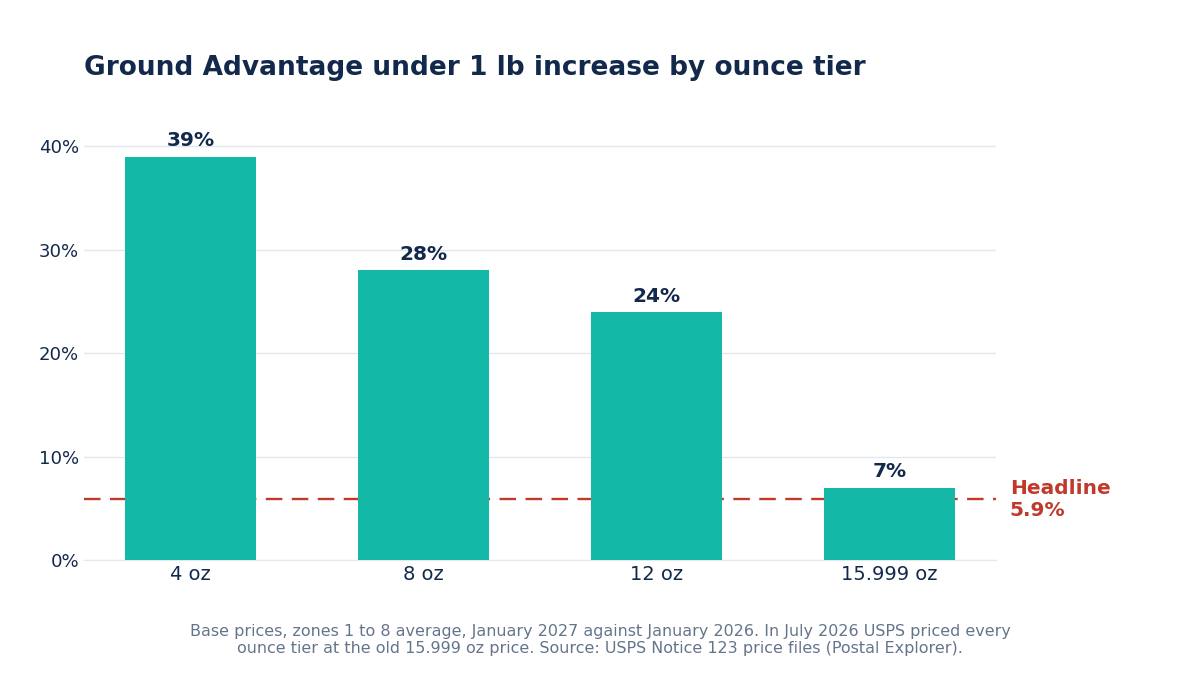
In July, USPS ended per ounce pricing for commercial Ground Advantage and priced every ounce tier at the old 15.999 oz price. January then adds about 7% on top of that flattened price, so the lightest tiers show the largest increases against January 2026: 4 oz up 39%, 8 oz up 28%, 12 oz up 24%, and the 15.999 oz tier itself up 7%.
Priority Mail: the increase lands in zones 1 to 4
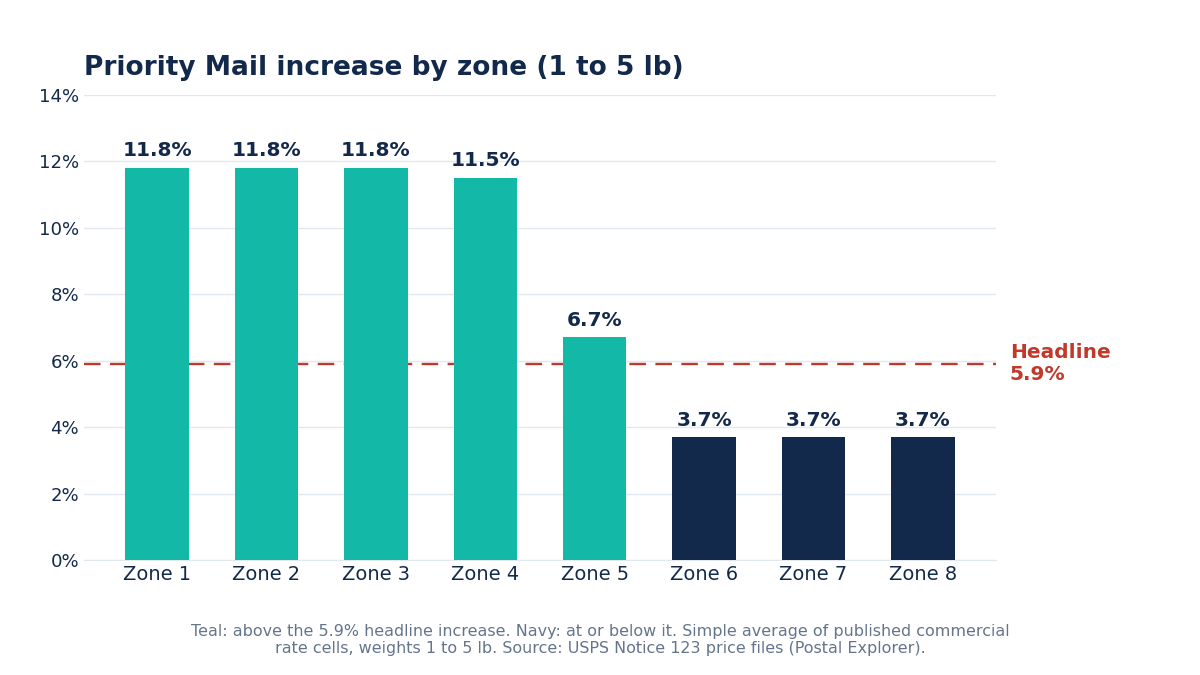
Priority Mail concentrates its increase in the short zones. For 1 to 5 lb, zones 1, 2, and 3 rise 11.8% and zone 4 rises 11.5%, about double the headline, while zone 5 rises 6.7% and zones 6, 7, and 8 rise 3.7%. Across the weight bands, 1 to 5 lb rises 11.7% in zones 1 to 4 against 4.5% in zones 5 to 8. The 6 to 10 lb band rises 10.9% against 4.5%. The 11 to 20 lb band rises 6.9% against 4.8%. And 21 lb and up rises 6.7% in every zone.
Parcel Select rises about 6% across weights and entry points, with 1 to 12 oz at 5.6%. Priority Mail Express runs the other way from Priority Mail, up about 1.5% in zones 1 to 4 and about 12% in zones 5 to 8.
A permanent fuel surcharge, starting at 11%
On January 17, the temporary 8% transportation charge expires, and a permanent fuel surcharge takes its place. The surcharge starts at 11%: the 8 points from April made permanent, plus another 3 points given the recent further elevation of fuel prices. USPS first announced a January fuel surcharge on October 26, 2026, in a fuel surcharge FAQ for business shippers. That announcement described a percentage that would update every week. This filing sets the starting rate at 11% and holds it flat for the January change.
How it is charged:
- It is a percentage of base postage on commercial rates. It is not charged on extra services or fees.
- Ground Advantage and Parcel Select follow diesel prices. Priority Mail and Priority Mail Express follow jet fuel prices.
- The tables USPS filed show 11% at every fuel price level, so the rate does not move with fuel prices for now.
- It is domestic only. International products are excluded for now.
- Negotiated contracts may carry customized fuel surcharge language, so if you ship under a negotiated agreement, check what yours says about fuel.
The surcharge is permanent. The 11% rate is not. USPS will reevaluate the rate in July 2027 based on fuel prices in the first half of the year, and it intends to move to weekly adjustments later in 2027, the way UPS and FedEx already work. For scale, USPS’s own filing puts the current ground fuel surcharges at roughly 28.25% for UPS and 29.75% for FedEx, so USPS starts well below the private carriers. The gap is not the story. The mechanism is. Once a weekly table is in place, this line of your postage can move without a new annual filing.
What this looks like on one package
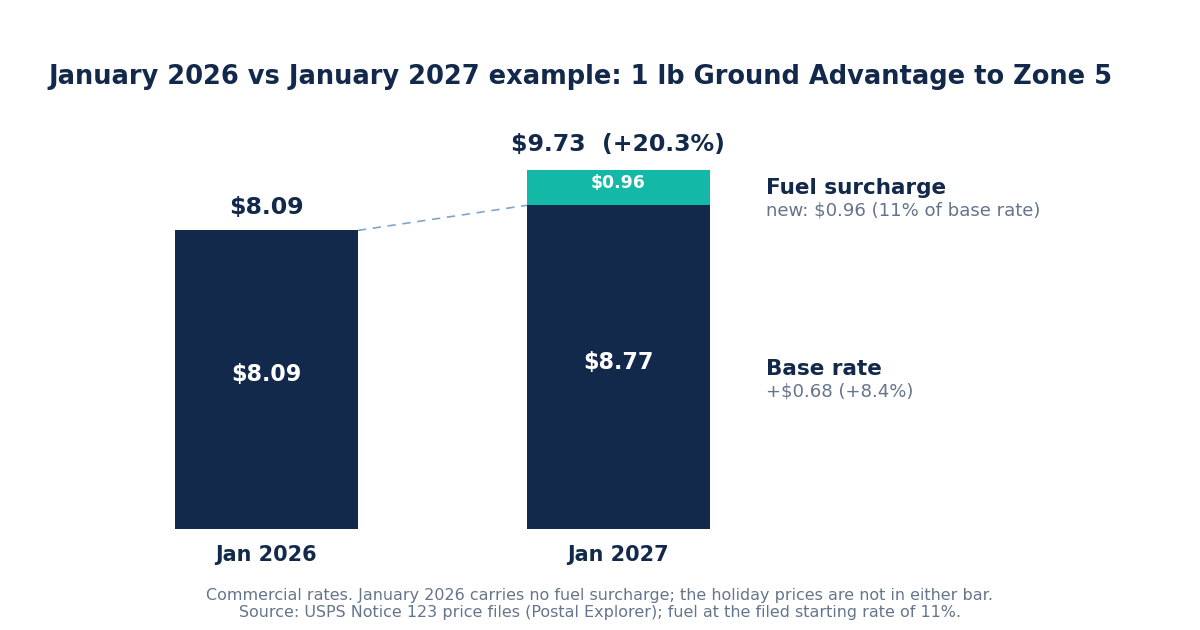
Take a 1 lb Ground Advantage package to Zone 5, at commercial rates:
| Jan 2026 | Jan 2027 | Change | |
|---|---|---|---|
| Base rate | $8.09 | $8.77 | +8.4% |
| Fuel surcharge | none | $0.96 (11%) | new |
| Total | $8.09 | $9.73 | +20.3% |
From April this label cost $8.74 with the temporary 8%, and the holiday price today is $9.29, so January lands about 5% above today. Nothing about the shipment changed. Only the calendar did.
New fees for bad data
USPS also reprices mistakes. A new repricing fee keeps 20% of any postage correction when weight or dimensions are wrong, in either direction: underpay and you owe the difference plus 20% of it, overpay and 20% comes off the refund. The $3 dimension fee is renamed the Dimension and Weight Noncompliance Fee, and it now covers missing weight as well as missing dimensions. A new $5 fee hits commercial parcels with barcodes USPS equipment cannot scan. The nonmailable charge for an overweight or oversized piece found in the network doubles to $400. And certain nonstandard fees rise 16%. All of it is avoidable with accurate data in the manifest.
What to do before January 17
Budget the stack, not the headline. The 5.9% base increase is measured against base prices before the temporary 8%, per the calculations in the filing. So against what you paid before the holiday prices started, the average stack is the base increase plus fuel moving from 8% to 11%: 1.059 x 1.11 / 1.08, which works out to roughly 8.8% more. That is an average built from the headline figures, not a forecast for your mix.
Model your short zone volume separately. Light parcels in zones 1 to 4 are where this increase concentrates, in both Priority Mail and Ground Advantage. If a large share of your orders lands within a few hundred miles, your increase will run well above 5.9% before fuel. Pull that volume out as its own line in the January budget.
Clean up weights, dimensions, and barcodes now. The fees section above is a price list for bad data, and the repricing fee makes it a percentage of every correction, not a flat charge. Fix it in the shipping system, in item data and manifest defaults, not label by label at the bench.
Plan for a moving surcharge. The 11% holds only until the July 2027 reevaluation, and USPS plans weekly adjustments after that. Budget fuel as a moving line and track it the way you track the UPS and FedEx fuel tables, not as a fixed 11% for the year.
Rate shop the short zones. The regional carriers in our regional parcel carriers guide built their networks on exactly these lanes. A lane that was a coin flip against Ground Advantage in 2026 may not be one in 2027. See economy ground services, compared for where FedEx Ground Economy, UPS Ground Saver, and USPS Ground Advantage each win.
For the other carriers’ increases, see the companion analyses: 2027 UPS GRI: What It Means for Shippers and 2027 FedEx GRI: What It Means for Shippers.
For how GRIs work every year, see our guide to the UPS and FedEx general rate increase.
Sources: USPS announcement, ‘U.S. Postal Service Recommends Shipping Price Adjustments for 2027,’ November 12, 2026; USPS filing in PRC Docket No. CP2027-1, Notice and Governors’ Decision No. 26-8; USPS Notice 123 price files, January 2026, Time-Limited 2026, and January 2027, Postal Explorer; USPS Fuel Surcharge Implementation FAQ, October 26, 2026; USPS holiday price announcement, August 25, 2026; Supply Chain Dive, October 26, 2026. All comparisons are commercial base prices before fuel unless stated. Averages are simple averages of the published rate cells for the weights and zones stated, computed from the USPS price files.