2027 FedEx GRI: What It Means for Shippers
FedEx list rates rise an average of 5.9% on January 4, 2027. Our analysis of FedEx's own tables shows where shippers will pay more than the headline.
Updated October 2026 · 9 min read

FedEx has announced its 2027 general rate increase: an average of 5.9% on list rates, effective January 4, 2027.
Treat that number as a starting point, not a forecast. FedEx does not raise every rate by 5.9%. It reprices thousands of individual cells, service by service, zone by zone, weight by weight, and then does the same to the surcharge table. We pulled FedEx’s published 2026 and 2027 Standard List Rates and its official 2027 surcharge and fee changes, and compared them cell by cell. The pattern underneath the headline is consistent: light packages, minimum charges, and accessorial fees take increases above 5.9%, while a few services were held below it.
The short version: 5.9% is the headline. The surcharge is the bill.
Base rates: where the increase actually lands
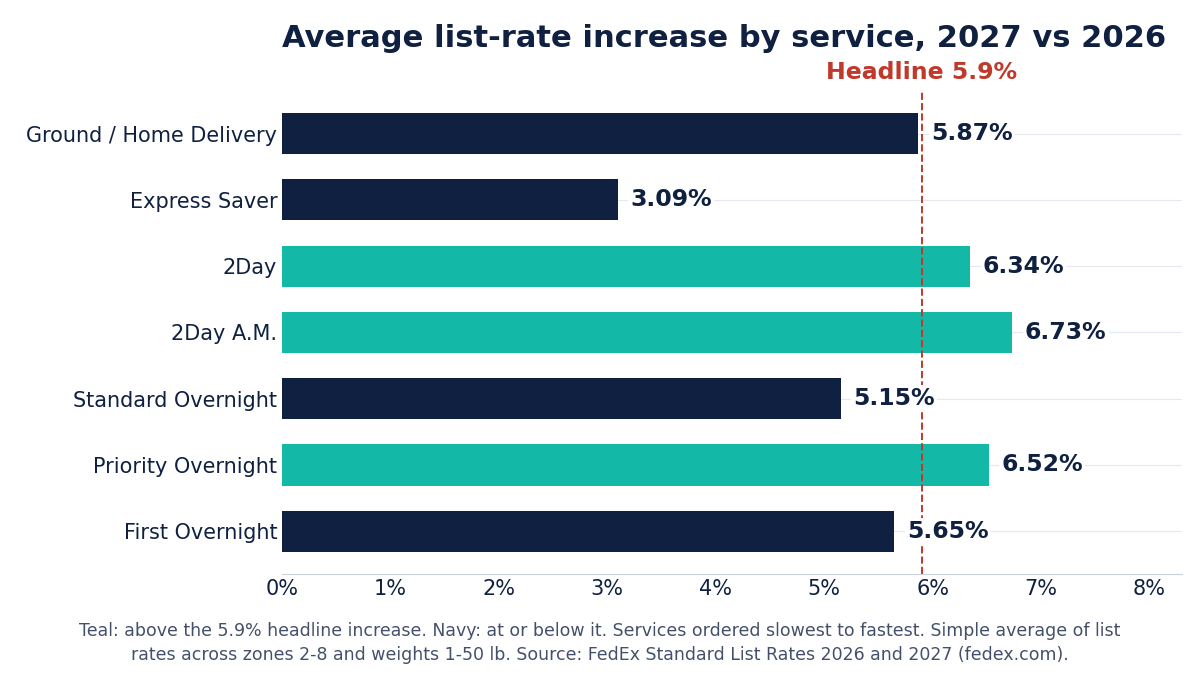
The table below shows each major service’s minimum charge (the Zone 2, 1 lb list rate, the floor under every shipment on that service) and the service’s average increase across zones 2-8 for packages from 1 to 50 lb.
| Service | 2026 min | 2027 min | Min change | Avg increase |
|---|---|---|---|---|
| Ground / Home Delivery | $11.99 | $12.70 | +5.92% | +5.87% |
| Express Saver | $23.84 | $24.67 | +3.48% | +3.09% |
| 2Day | $26.46 | $28.15 | +6.39% | +6.34% |
| 2Day A.M. | $30.21 | $31.99 | +5.89% | +6.73% |
| Standard Overnight | $40.82 | $43.22 | +5.88% | +5.15% |
| Priority Overnight | $45.22 | $48.34 | +6.90% | +6.52% |
| First Overnight | $76.22 | $79.34 | +4.09% | +5.65% |
Three things stand out.
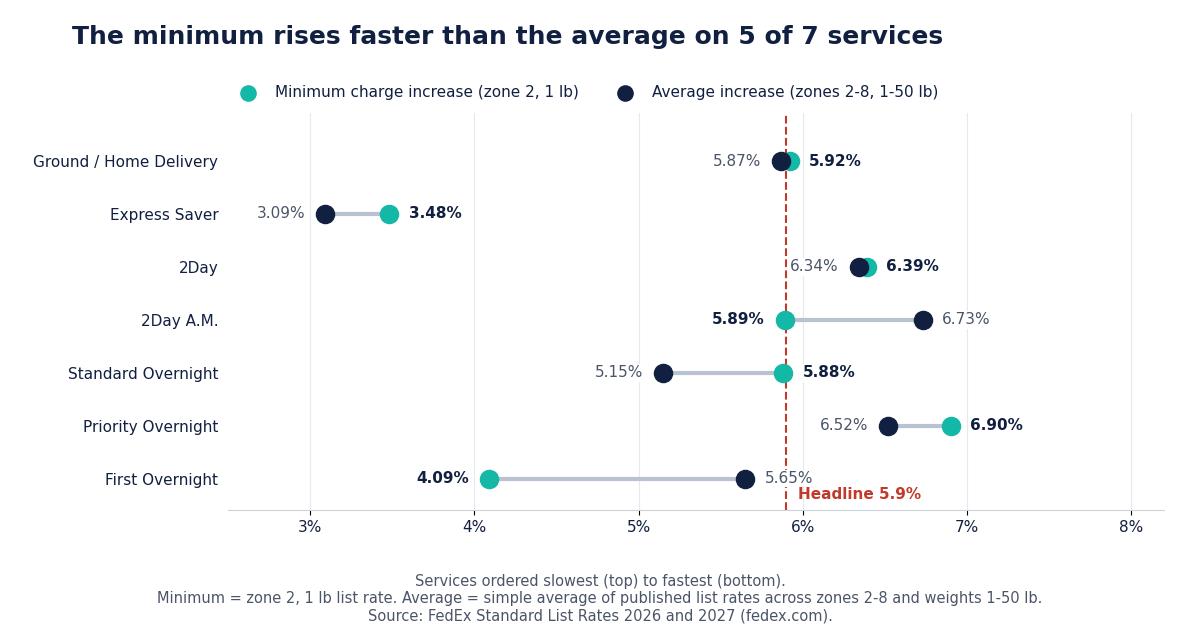
The minimum charge rises faster than the rates on most services. The Priority Overnight minimum rises 6.90%, ahead of that service’s 6.52% average increase. The Ground minimum rises 5.92% to $12.70, the Standard Overnight minimum 5.88% against a 5.15% average, the 2Day minimum 6.39% against a 6.34% average, and the Express Saver minimum 3.48% against a 3.09% average. Five of the seven minimums in the table rise faster than their service averages. First Overnight and 2Day A.M. are the exceptions: their minimums rise more slowly. The minimum is the least a shipper can pay per package no matter how strong the negotiated discount is, so where it outruns the rates, every point of minimum increase cancels a point of discount on light, short-zone packages. It has to be negotiated on its own terms.
Express Saver was held down. At +3.09%, Express Saver takes about half the increase of 2Day and sits well below every other service in the table. If your freight can tolerate a third day, note that 2Day rises more than three points faster than Express Saver this year. Model the switch before your next renewal, not after.
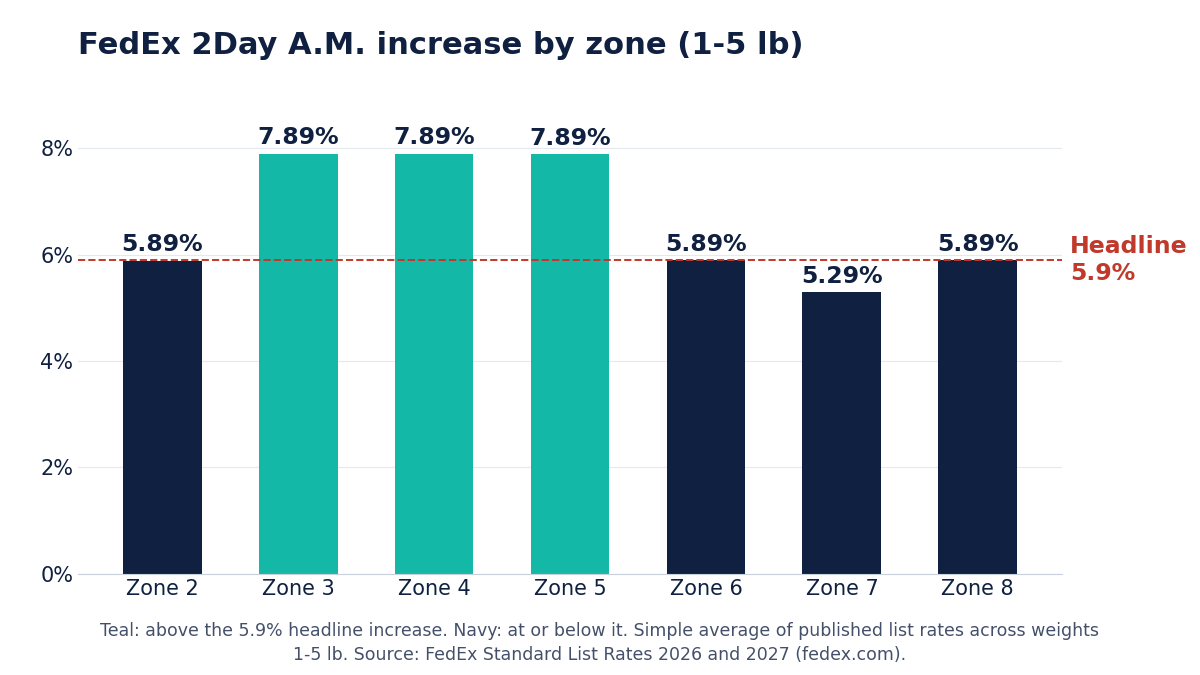
Middle-zone air takes the steepest increases in the table. FedEx 2Day A.M. rises about 7.9% in zones 3, 4, and 5 (for packages from 1 to 5 lb), then drops back to between 5.3% and 5.9% in zones 6 through 8. Standard Overnight spikes to 6.5% in zone 3 against 4.9% across zones 4 through 8. If your Express volume concentrates in the middle zones, your effective increase runs well past the headline no matter what your discount sheet says.
Ground: the lightest packages pay the most
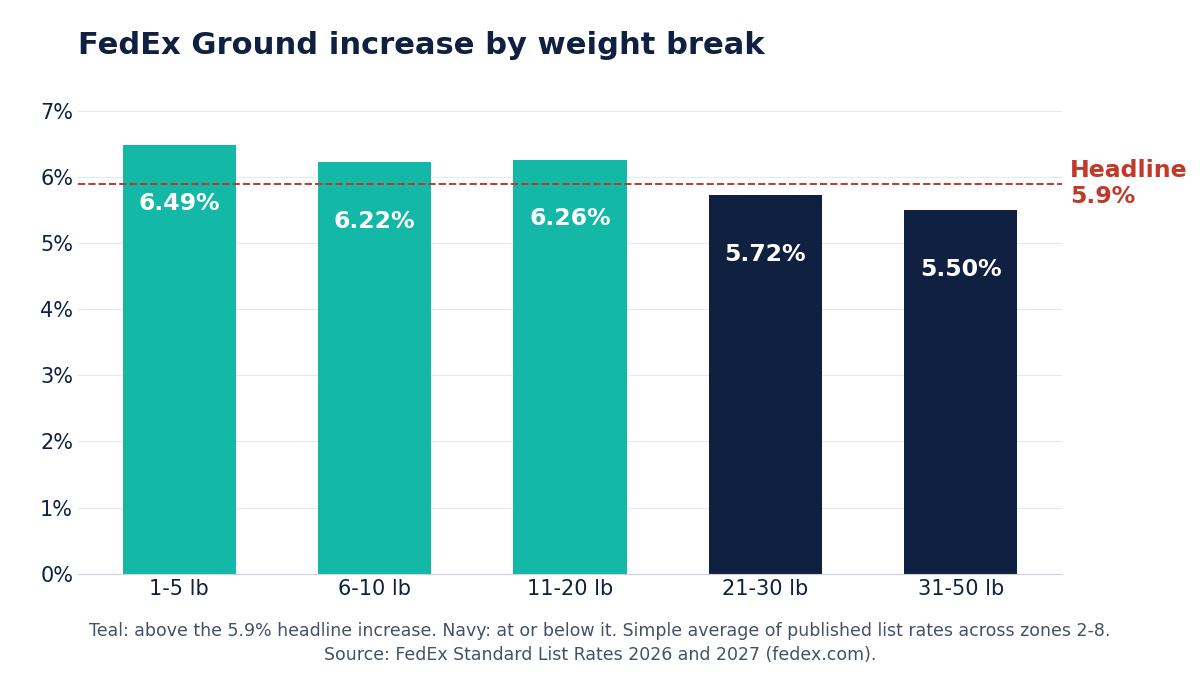
Ground increases are close to uniform across zones this year. The tilt is by weight instead, and it points straight at e-commerce volume, with each break averaged across zones 2-8:
| Weight | Avg increase |
|---|---|
| 1-5 lb | +6.49% |
| 6-10 lb | +6.22% |
| 11-20 lb | +6.26% |
| 21-30 lb | +5.72% |
| 31-50 lb | +5.50% |
The 1 to 5 lb break, which covers most residential e-commerce shipments, takes the steepest increase in the Ground table, and it lands on the same packages the higher minimum charge hits. A light, high-count shipping profile gets both at once.
The surcharge table: the part that grows faster
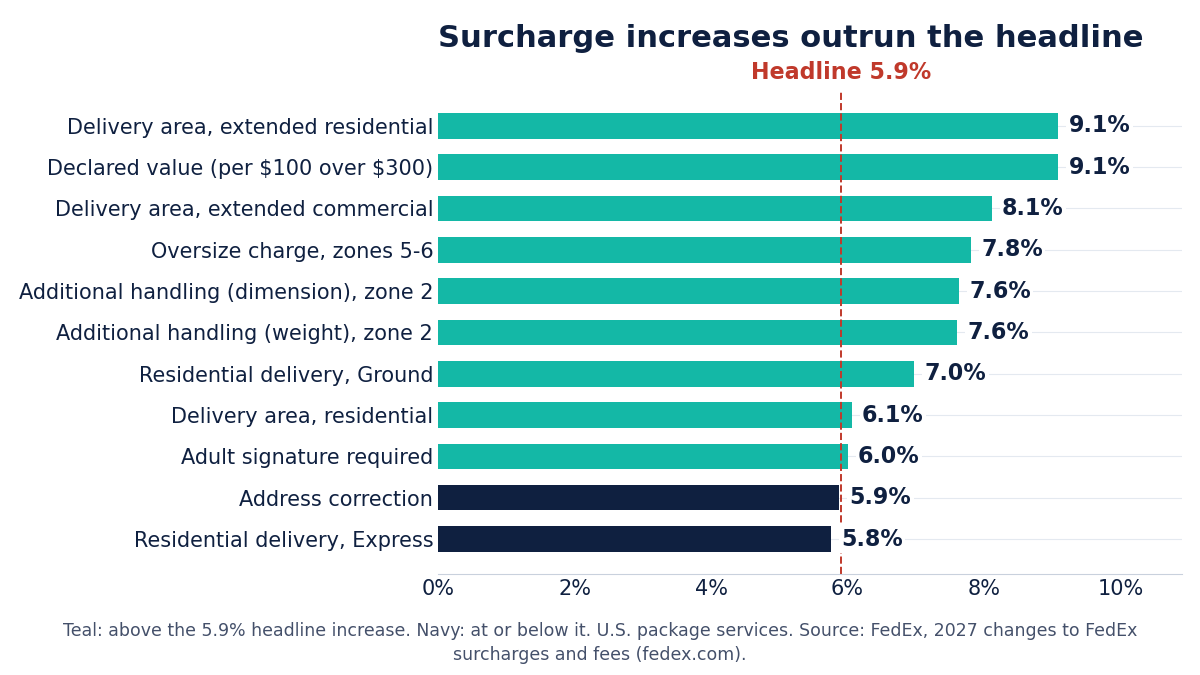
Base rates are only half the invoice. FedEx’s 2027 surcharge and fee changes raise most accessorials by more than 5.9%, several of them by a lot more. These are FedEx’s published U.S. package fees for 2026 and 2027, from its own changes document.
| Surcharge | 2026 | 2027 | Change |
|---|---|---|---|
| Additional handling, dimension, zone 2 | $29.50 | $31.75 | +7.6% |
| Additional handling, dimension, zones 3-4 | $32.75 | $35.25 | +7.6% |
| Additional handling, dimension, zones 5-6 | $38.50 | $41.25 | +7.1% |
| Additional handling, dimension, zone 7+ | $40.75 | $43.75 | +7.4% |
| Additional handling, weight, zone 2 | $46.00 | $49.50 | +7.6% |
| Additional handling, weight, zones 3-4 | $50.25 | $54.00 | +7.5% |
| Additional handling, weight, zones 5-6 | $56.25 | $60.25 | +7.1% |
| Additional handling, weight, zone 7+ | $58.75 | $63.00 | +7.2% |
| Additional handling, packaging, zone 2 | $26.50 | $28.50 | +7.5% |
| Additional handling, packaging, zones 3-4 | $30.75 | $33.00 | +7.3% |
| Additional handling, packaging, zones 5-6 | $33.00 | $35.25 | +6.8% |
| Additional handling, packaging, zone 7+ | $33.75 | $36.25 | +7.4% |
| Oversize charge, zone 2 | $255.00 | $270.00 | +5.9% |
| Oversize charge, zones 3-4 | $275.00 | $290.00 | +5.5% |
| Oversize charge, zones 5-6 | $320.00 | $345.00 | +7.8% |
| Oversize charge, zone 7+ | $330.00 | $355.00 | +7.6% |
| Residential delivery, Express | $6.95 | $7.35 | +5.8% |
| Residential delivery, Ground/Home | $6.45 | $6.90 | +7.0% |
| Delivery area, residential | $6.60 | $7.00 | +6.1% |
| Delivery area, extended residential | $8.80 | $9.60 | +9.1% |
| Delivery area, commercial | $4.45 | $4.70 | +5.6% |
| Delivery area, extended commercial | $5.55 | $6.00 | +8.1% |
| Delivery area, remote | $16.75 | $17.75 | +6.0% |
| Address correction | $25.50 | $27.00 | +5.9% |
| Declared value, $100.01 to $300 | $4.95 | $5.40 | +9.1% |
| Declared value, per $100 over $300 | $1.65 | $1.80 | +9.1% |
| Signature, adult required | $10.00 | $10.60 | +6.0% |
| Signature, direct required | $7.60 | $8.15 | +7.2% |
| Signature, indirect required | $7.60 | $8.05 | +5.9% |
Additional handling deserves a hard look. All three triggers (dimension, weight, and packaging) and every zone band rise between 6.8% and 7.6%. It behaves like a single block increase now, set well above base rates, and it applies on top of them. Extended residential ties declared value as the fastest mover in the table at +9.1%, with extended commercial close behind at +8.1%. Rural and fringe addresses are where FedEx is pricing hardest in 2027.
Pickup fees climb too. A regularly scheduled five-day pickup week goes from $35.50 to $38.95 (+9.7%), and the residential pickup surcharge rises from $5.95 to $6.50 per stop (+9.2%).
Most accessorial discounts are written as a percentage off the published fee. When the published fee climbs 7.6% and the discount percentage stays where it is, your cost climbs the full 7.6%. Percentage discounts do not protect you from the surcharge table. Dollar caps and fixed fee terms do, and they are the terms carriers resist most.
What this looks like on one package
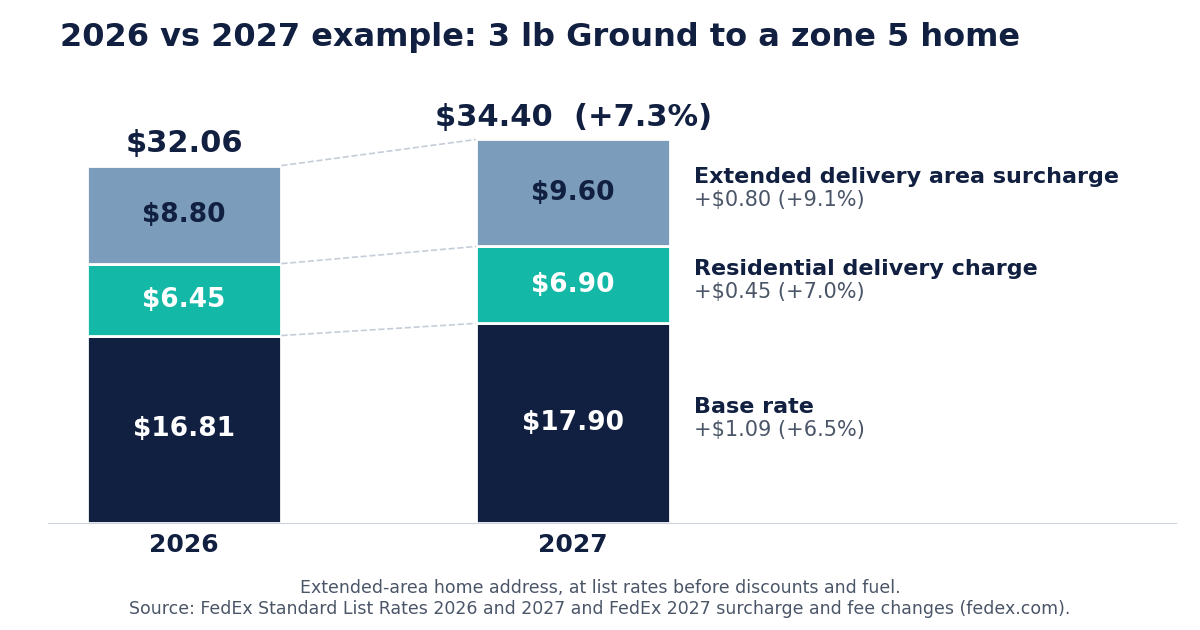
Take a 3 lb Ground package to a zone 5 home address, at list rates:
| 2026 | 2027 | Change | |
|---|---|---|---|
| Base rate | $16.81 | $17.90 | +6.5% |
| Residential delivery charge | $6.45 | $6.90 | +7.0% |
| Total | $23.26 | $24.80 | +6.6% |
If that home sits in an extended delivery area, add the extended residential delivery area surcharge ($8.80, rising to $9.60) and the same package goes from $32.06 to $34.40, a +7.3% increase. Nothing about the shipment changed. Only the calendar did.
What to do before January 4
Price your own mix, not the average. The 5.9% figure blends services you may not use. Run your last 90 days of shipments against the 2027 tables by service, zone, and weight, and count how many of your packages touch the fees above. That number, not the headline, is your 2027 budget problem.
Add fuel on top. The fuel surcharge is a percentage, so it is calculated on the higher 2027 figures. Every increase above raises the fuel dollars on the invoice too, even if the fuel percentage itself never changes.
Negotiate the minimum and the fees explicitly. A better base discount does nothing for a package priced at the minimum, and nothing for a percentage-discounted surcharge. Minimum charge relief, accessorial caps, and fixed fee schedules are separate asks, and they belong in the same conversation as base rates. This is the core of carrier contract negotiation done properly.
Check your surcharge exposure. If additional handling, oversize, or delivery area fees show up on your invoices regularly, small changes in packaging and address quality pay back faster after this increase than before it. Our guide to small parcel shipping walks through the triggers and how to test your own packages.
Revisit your service mix. The Express Saver carve-out and the middle-zone 2Day A.M. spike mean the cheapest routing in 2026 is not automatically the cheapest in 2027. A free savings report will show what these tables do to your actual profile.
For how GRIs work every year, see our guide to the UPS and FedEx general rate increase.
Sources: FedEx, 2027 changes to FedEx surcharges & fees; FedEx Standard List Rates 2027 and Standard List Rates 2026 (fedex.com). All comparisons are list rates before negotiated discounts and fuel surcharges, effective January 4, 2027. Averages are simple averages of the published rate cells across zones 2-8 for the weight bands stated, computed from the FedEx tables.