
Every fall, UPS and FedEx announce a general rate increase, the GRI. Every winter, it takes effect, and nearly every shipper’s parcel costs go up. The announcement is a single percentage. Your actual increase almost never matches it, and it often lands higher.
“When UPS and FedEx announce a general rate increase, the headline percentage is the average increase across all of their customers’ volume for a service like Ground. If your volume mix is not precisely the average, your actual increase will differ.”
Timur Eligulashvili, founder of SmallParcel.com
This guide explains how the GRI works, why the headline number understates what you will really pay, and which parts of your carrier agreement are worth negotiating before the new rates land. When you want a specific year’s numbers, start with the references linked just below.
Rate increase references
2027 general rate increase
FedEx analysis: 2027 FedEx GRI: What It Means for Shippers
UPS analysis: coming soon (not announced yet)
2026 general rate increase
Video breakdown: the Logistics Remix Holiday Special, where LPF Spend Management founder Nate Skiver walks through the 2026 increases service by service and shows how to calculate what they did to a real shipping profile.
What a GRI actually is
The GRI is a repricing of the carriers’ published list rates: the standard rate tables for every service, zone, and weight. It is not a change to your contract and it is not a surcharge. The announced percentage is an average across the whole table.
Two things follow from that. First, almost no individual rate rises by exactly the headline percentage. Each cell in the table moves on its own, some by less, many by more, and the average is what gets announced. Second, the increase applies to list rates before your discounts. What it does to your invoices depends on how your agreement is built: your discount percentages, your minimum charges, and which fees your volume actually touches.
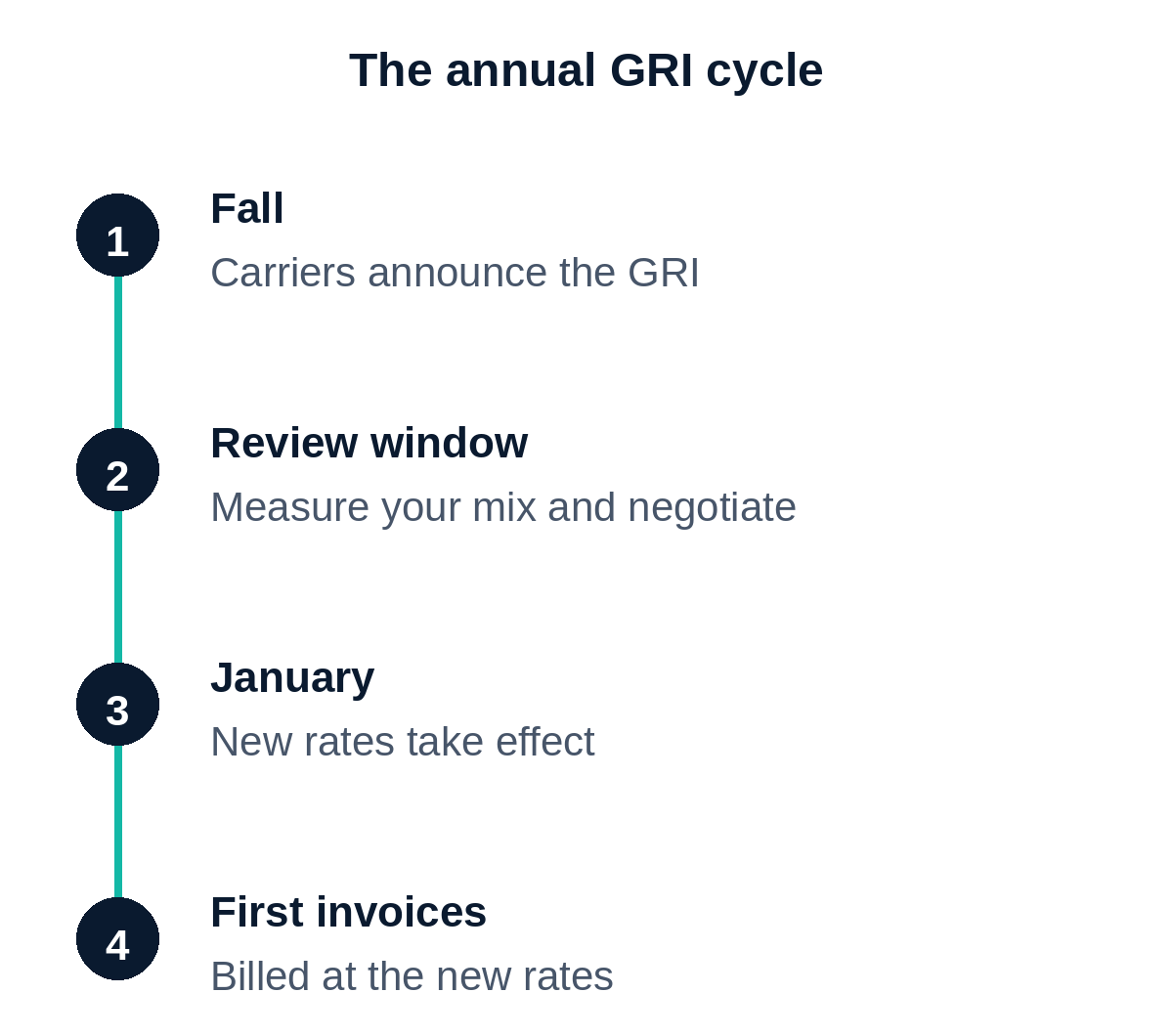
GRIs arrive on a predictable calendar. The announcements come in the fall, and the new tables take effect around the start of the year. That gap is your working window, and it is the same every year.
Why the headline understates your increase
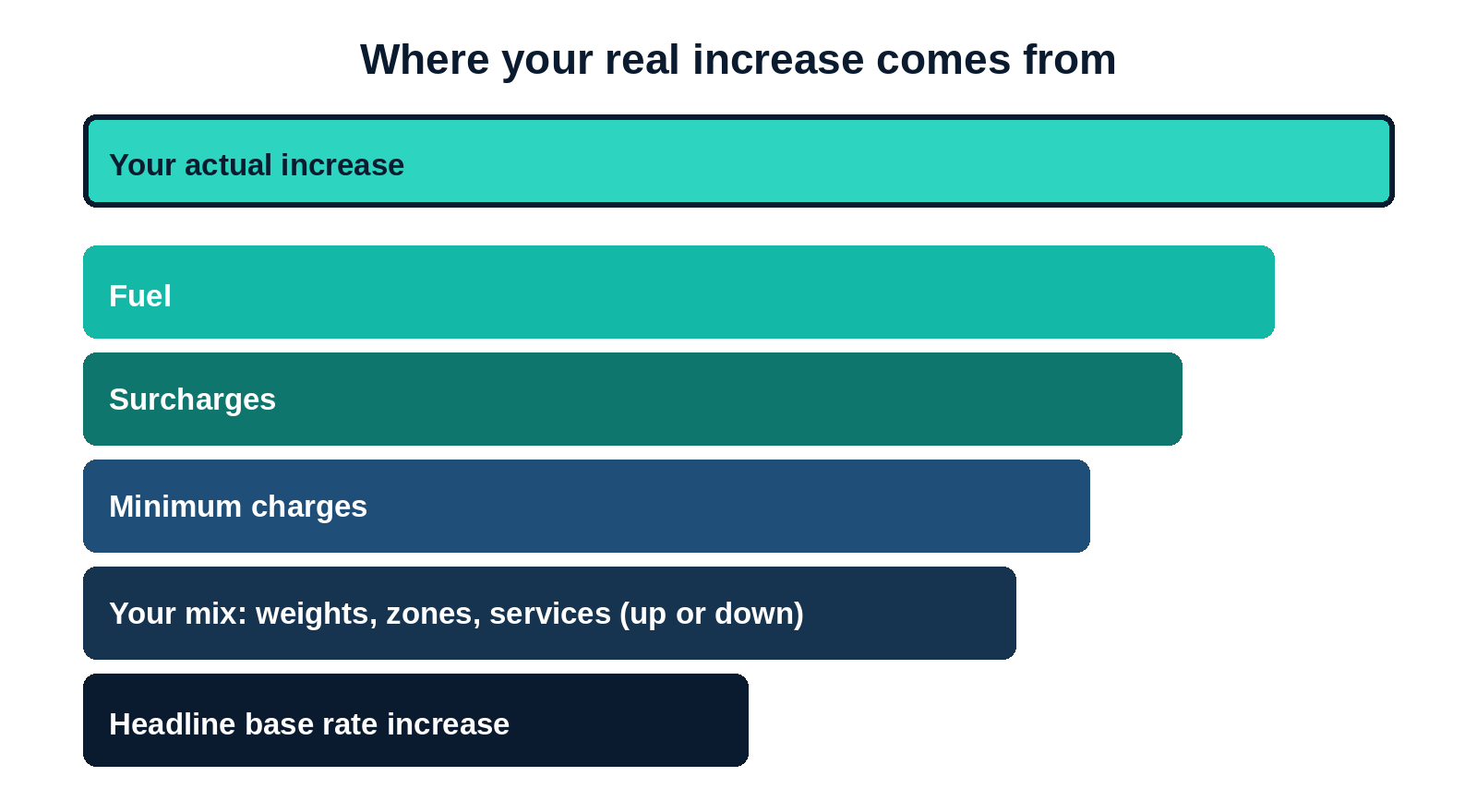
The average blends freight you do not ship. A carrier-wide average mixes light and heavy packages, short and long zones, ground and air. Your shipping profile is not average. If your volume concentrates where the carriers raised rates fastest, your increase runs ahead of the headline no matter what your discount sheet says.
Light packages often take the steepest increases. Residential e-commerce volume is the growth business for both carriers, and the rate tables price it that way. The lightest weight breaks and the per-package minimum charge tend to rise faster than the overall average, and they hit the same shipments at the same time.
The minimum charge is a floor your discount cannot reach. Every service has a minimum charge, the least you can pay for a package on that service no matter how strong your negotiated discount is. When the minimum rises faster than the rates around it, it quietly cancels part of your discount on light, short-zone packages. That is why it gets its own lever in the negotiation section below.
Your mix matters more than the mean. Two shippers with identical discounts can see very different increases from the same GRI, because their services, zones, weights, and delivery types differ. The only honest forecast is your own shipment history run against the new tables.
The surcharge table moves on its own
Base rates are only part of the invoice. Alongside the GRI, the carriers publish separate changes to surcharges and fees: additional handling, oversize, residential delivery, delivery area, address correction, declared value, pickup fees, and more. These are repriced on their own schedule, and many of them climb faster than the headline rate increase. Those same fee changes are where invoice errors pile up, which is what a parcel audit catches.
This is where GRI announcements mislead by omission. The press release is about base rates. The fee changes sit in a separate document that most shippers never open.
It matters because of how accessorial discounts are usually written. Most are a percentage off the published fee. When the published fee rises and your discount percentage stays put, your cost rises by the full amount of the fee increase. Percentage discounts do not protect you from the surcharge table. Dollar caps and fixed fee schedules do, and they are separate negotiation asks from base rates.
Add fuel on top
The fuel surcharge is calculated as a percentage of the charges on the shipment. When base rates and fees rise, the fuel dollars on each invoice rise with them, even if the fuel percentage itself never changes. Every GRI increase compounds through fuel. Budget for it, or your January forecast will be light.
How to find your real number
Before you negotiate, measure. Take your last 90 days of shipments and reprice them against the incoming tables: by service, zone, and weight, with the new surcharge schedule applied and your current discounts and minimums in place. Count how many of your packages touch the fees that rose fastest. The output is your real increase, usually stated as a range across your service mix, and it is the only number worth taking into a negotiation.
Our guide to small parcel shipping walks through the rate and surcharge mechanics in more depth if you want the full picture of how a parcel bill is built.
What to negotiate
Five levers matter most. Each gets a short summary here; the depth lives in our parcel contract negotiation guide.
Minimum charges. If a meaningful share of your packages prices at the minimum, the minimum is effectively your rate. It has to be negotiated on its own terms, not through base discounts that never reach those packages.
Surcharge caps and fixed fees. For the fees you touch most, dollar caps or fixed fee schedules hold up better than percentage discounts when the published fees are repriced above them.
Discount structure. A deeper discount on services you barely use is worth less than a moderate one on your core mix. Negotiate where your volume actually is, and check the structure still fits after the new tables land.
Service mix. An increase that lands unevenly across services can reorder the cheapest routing for your lanes. Revisit service selection for your heaviest profiles before the effective date, not after a quarter of invoices at the new rates.
A GRI cap. A shipper can also negotiate a cap on how much of the annual GRI passes through to its rates. Carriers generally reserve that protection for very large shippers, so most agreements will not carry one.
This is the work of carrier contract negotiation done properly: the GRI is an annual, predictable repricing, and the agreements that hold up best are the ones negotiated with the new tables already in view.
Frequently asked questions
When are GRIs announced?
Both carriers announce their GRIs in the fall, a few months before the new rates take effect. The announcement headlines the list rate tables; the surcharge and fee changes are published alongside it, in separate documents most shippers never open.
When do new rates take effect?
The new tables take effect around the start of the year, in the winter following the announcement. Until then, invoices keep pricing on the current tables, which makes the gap between the announcement and the effective date the window to measure your exposure and negotiate.
Does the GRI apply to my discounted rates?
The GRI reprices the published list rates underneath your agreement, so it flows into your invoices even with negotiated discounts in place. How much of it you feel depends on your discount structure and your minimum charges, which is why two shippers facing the same headline see different increases.
Can you negotiate the GRI?
You cannot negotiate the published tables; those are the carriers’ list rates and they apply to everyone. What you can negotiate is how the increase lands on your agreement: minimum charges, surcharge terms, discount structure, and, for very large shippers, a cap on how much of the GRI passes through.