Faster.
On the right lanes, transit times can beat the national carriers.
Home / Services / Regional Carriers
Service
Keep your national carrier. Add carriers where they win. On the right lanes, from short zones to coast to coast, regional and alternative carriers can deliver faster and cost less than UPS and FedEx. We find the ones that fit your shipping profile and put you in front of the right people.
Fill out the form and a person will reach out. We will look at your lanes and tell you where an alternative fits, then bring in the right carriers for rates on your real shipments. Nothing moves until you choose.
Free, no obligation.
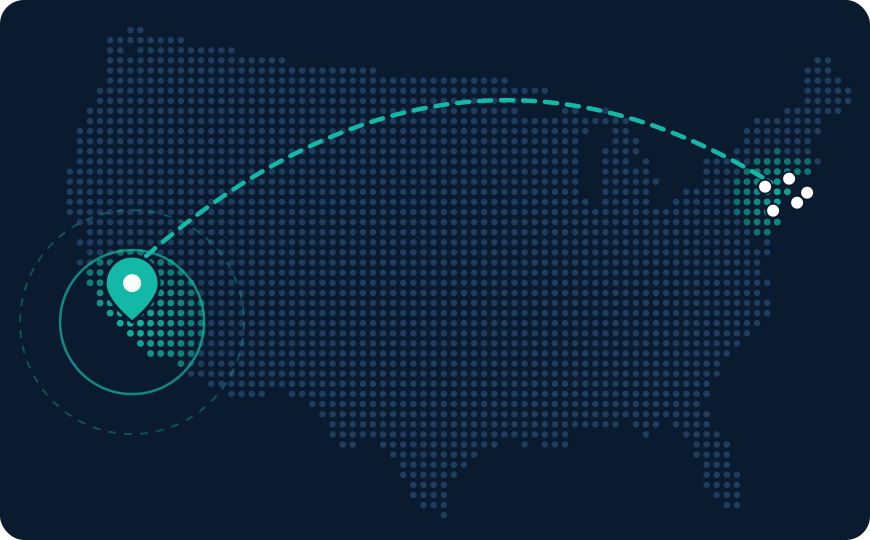
The term covers a lot: regional networks plus newer alternative carriers that win on specific lanes. We look at where your packages go and which lanes an alternative serves better. You can preview the field yourself in our alternative carrier finder, which lists the carriers by the states they cover. Three situations come up most often.
Customers within a few hundred miles of the warehouse. As we discussed on our Logistics Remix episode about why shippers hesitate to leave UPS and FedEx, volume delivering within about 250 miles of the warehouse is often overpaying on UPS or FedEx. Short zones are the classic fit.
Some alternative carriers reach far beyond their home territory through a middle mile: they move packages long distance in bulk, then hand them into regional delivery networks near the customer. Short zones are one strength, not the limit.
Many alternatives built their networks around home delivery from the start, and they compete hard on residential lanes. If most of your volume goes to doorsteps, the comparison is worth running. See how regional and alternative carriers fit the picture in section 9 of our small parcel guide.
We bring in the right carriers and set up the intro calls. The carriers review your shipment data and present rates on your actual shipments. Compare offers on the all-in rate, not a rate card. Our ground services comparison shows how rates, minimums, and surcharges stack into the all-in rate.
You sign directly with the carrier and add it to your shipping platform. We set up recurring pickups and the rest of the details so day one runs smoothly. Nothing changes in how you ship on the volume you keep with your national carrier.
Adding a carrier is carrier diversification in its simplest form. On the right lanes, alternatives to UPS and FedEx can be faster, easier to work with, or lower cost than your national carrier.
On the right lanes, transit times can beat the national carriers.
Smaller networks often mean direct contacts and quicker answers.
Priced on your actual shipments, the all-in rate can come in under UPS and FedEx.
Depending on your lanes, you might get one of these, two, or all three. We find out which before you commit to anything. And a second carrier means you are not stuck when one has a bad week.
We learn your company, your warehouse locations, and where your customers are.
We sign an NDA first. Then share package level detail: recent shipment history with origins, destinations, weights, and dimensions. Our playbook includes a PLD checklist you can copy into an email.
Intro calls with the regional shipping carriers that fit your lanes. They review your data and present rates.
You pick the offer that works and sign directly with the carrier.
You add the carrier to your shipping platform. We set up recurring pickups and the details so it goes smoothly.
The honest version: regional carriers are a supplement, not a replacement. Every one has coverage gaps. That is why you keep your national carrier and add regionals only where they win.
We start with your lanes and your profile, not a carrier we want to sell. The recommendation comes from your shipment data, not a pitch deck.
Years of relationships with small parcel carriers across the regional and alternative landscape. We recommend based on your lanes, not on who has the best pitch.
We put you in front of the right people at each carrier, not a general sales inbox. The right person at a carrier can mean a fast, direct answer.
Want better terms on your current contract too? See Carrier Contract Optimization.
Adding a carrier takes integration, testing, and ramp time. Aim to be fully onboarded by late spring, not during the run-up to peak.
Regional parcel carriers are small parcel carriers that concentrate volume in dense delivery networks instead of covering the whole country themselves. The broader term is alternative carriers: regionals plus emerging carriers that compete with UPS and FedEx on price and speed. Some reach coast to coast through a middle mile, moving packages long distance in bulk and handing them into regional delivery networks near the customer.
Yes. Some go coast to coast through a middle mile. Coverage varies by carrier, which is why we start with your lanes before recommending anyone.
On the right lanes, often. It depends on your profile and the all-in rate. The comparison we run prices your actual shipments, so you see the real number, not a generic discount.
No. Keep your national carrier. You add regionals only on the lanes where they win. Most shippers run a national carrier alongside one or more alternatives.
Many. We recommend based on your lanes, not from a fixed list. See section 9 of our small parcel guide for the full list of providers we draw from.
The carrier, directly. We make the introduction and help with the launch, but the agreement is between you and the carrier.
It depends on your profile and the carriers involved. The process runs through data review, rates, an agreement, integration with your shipping platform, testing, and ramp time. That is why the timing section above says to aim for onboarding by late spring rather than during the run-up to peak.
A conversation about your company and your shipping profile. Then we sign an NDA and you share package level detail. That is the whole start.
Fill out the form and a person will reach out. We will review your lanes, bring in the right carriers, and get you rate offers on your real shipments, then help you launch with pickups set up. Free, no obligation.